Smart Space Planning for All Hands Spaces

In recent years, all-hands spaces have become increasingly popular across a wide range of organizations because they address contemporary communication and collaboration needs in a dynamic, hybrid work environment.
To maximize ROI of a town hall space, it’s important to engage in smart space planning that considers all your anticipated use cases as well as architectural and budgetary constraints. After all, a town hall environment requires an investment not only in design and integration but in ongoing operation and maintenance, and the best way to balance costs and benefits is to plan carefully from the beginning.
Define your objectives for an all-hands / town hall space
Not only do large organizations and enterprises have remote and in-office team members to engage but they also use AV technology to communicate with geographically dispersed customers, vendors, partners, investors and other stakeholders. Hence, in an era of technology-driven collaboration, modern town halls are used for a variety of purposes, including company-wide meetings, training sessions, product launches, client presentations and social events.
Accordingly, the first step for space planners is to account for all the activities that will take place in your town hall. The goal is to accommodate not just the highest-profile events, but the full range of use cases. For example, a hybrid meeting room setup that can host company-wide gatherings for, say, a major product rollout can also be designed to accommodate daily collaboration on most any scale. Certain design features can also be added that will make your space viable as a money-earning rental facility.

Consider all-hands room configuration strategies for AV-enabled hybrid events
Whether you’re creating an AV-equipped town hall environment from the ground-up, renovating an all-hands space, or adapting an existing facility to function as a town hall, you have a number of configuration options that will bear directly on how the environment can be used.
First, consider how many people the town hall will need to accommodate, and in what types of gatherings. Do you anticipate holding separate events simultaneously or hosting gatherings that involve breakout sessions? If so, you may wish to incorporate air walls into your environment. These movable partitions can effectively segment your space while providing a degree of sound isolation. Couple them with zoned and/or movable displays and audio technology, and you can transform one large environment into multiple ones in much the same way that hotels and conference centers routinely divide a grand ballroom into smaller gathering spaces.
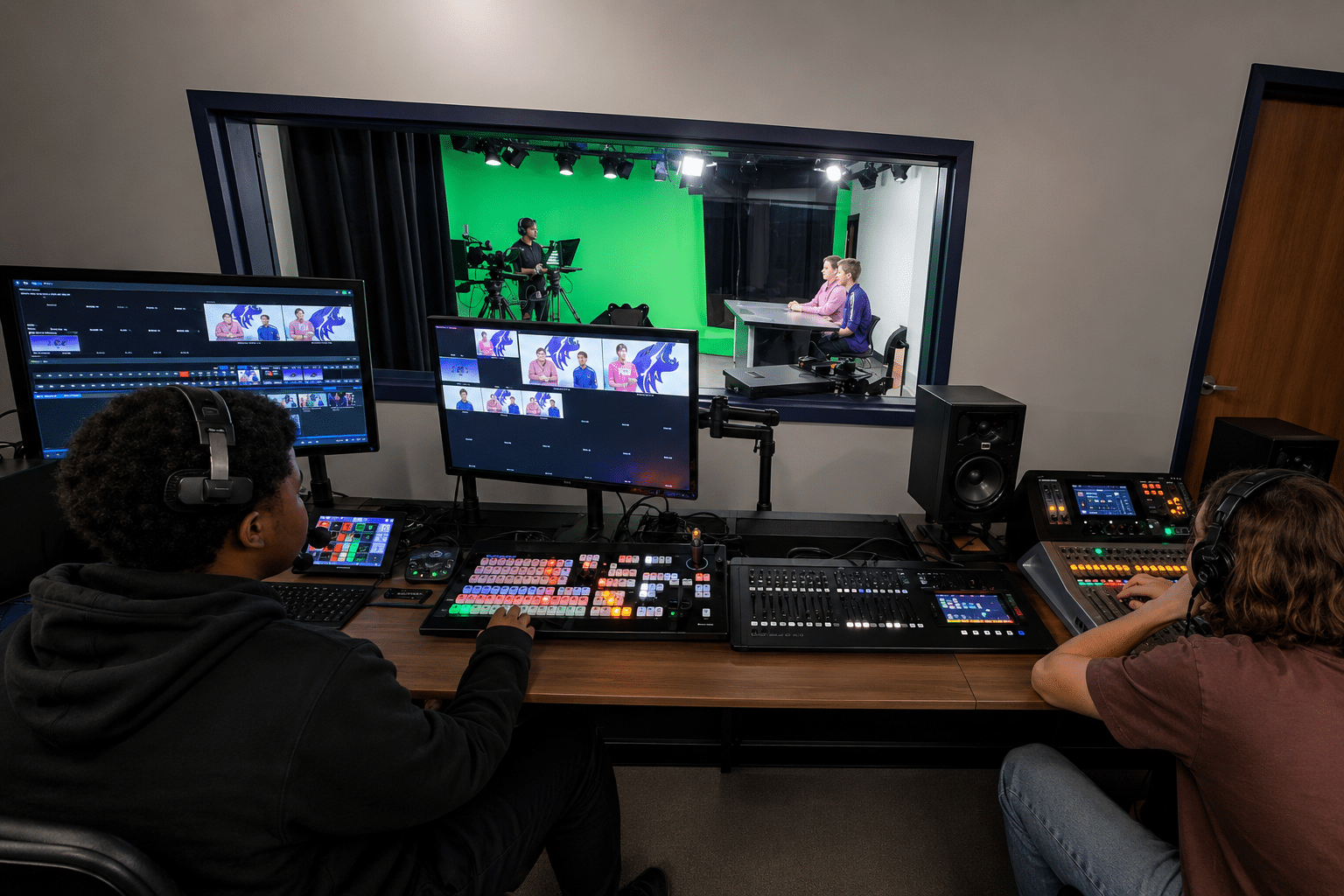
It’s also important to consider auxiliary spaces, including rack rooms or closets, control rooms and green rooms. If you anticipate producing and broadcasting large-scale, highly choreographed events, it’s likely that you’ll want to create separate equipment and control rooms that optimize security, access, energy efficiency, ergonomics and comfort. Likewise, a green room can be an invaluable amenity for events with multiple, queued presenters who’ll need hair and makeup as well as rehearsal space.
Optimize Seating and Sightlines for Hybrid Town Hall Gatherings
Consider the best way to engage your audiences and maximize presenter impact across your use cases. Will an auditorium-like space with tiered seating work harder for you, or will you gain more value from a flat, open-plan expanse where foldable seating can be arrayed as needed?
Also important: the ways audiences will participate in your town halls. If you anticipate interactive sessions with Q&A, etc., space planners will need to consider the required audio and lighting equipment to ensure all audience members – including those who will benefit from accessibility technology – can hear, be heard and be seen. It’s especially important to get the audio right for your various seating configurations, as anything less than the optimal use of speakers, microphones and acoustic treatments will hinder audience engagement.
Integrate Technology in Room Planning
Those charged with all-hands space planning have to consider technology integration from various perspectives, but two areas bear special mention.
First is your combination of built-in and mobile AV solutions. Technologies like beam-forming microphones address both aspects of design. While they may be ceiling mounted or embedded into conference tables, these devices can integrate with video conferencing systems to automatically cover active those who are speaking – wherever they are, even as they move about the room. Other AV solutions, like displays, can be deployed in fixed as well as mobile applications. Zoned LED and projection displays, for example, can be mounted strategically throughout the space to account for various room configuration needs. They can also be complemented by mobile displays, even ones as simple as a fixed 80” screen on a rolling cart.
It’s also valuable to design your space with an eye toward future proofing with scalable infrastructure. First, take full advantage of network-centric AV infrastructure to support scalable video and audio distribution. Use a high-bandwidth, low-latency network to accommodate future expansion and higher resolutions and ensure network switches support PoE+ or PoE++ to power devices like ceiling microphones, PTZ cameras and control panels without additional cabling. Along with beamforming microphones and DSP systems that allow for expansion without requiring major hardware changes, implement Dante or ADS67-compatible networked audio for flexible routing, easy expansion and integration with future audio devices.
Expandable video systems, flexible control and automation, hybrid and remote collaboration readiness, high-quality structured cabling that accounts for future bandwidth needs, and cloud & remote management capabilities that support proactive maintenance and monitoring will also go a long way toward future proofing your town hall.
Identify Best Practices for Adapting Existing Facilities
When updating or creating town hall environments in existing facilities, space planners will need to navigate architectural constraints, legacy infrastructure and evolving user needs.
The first thing you’ll want to do is conduct a thorough site survey and needs assessment that evaluates existing infrastructure, identifies past AV challenges (like poor sound reinforcement, video latency or insufficient camera coverage), and incorporates insights from IT teams, facilities management and end users. Again, pay especially close attention to audio quality and acoustic treatment by upgrading or enhancing microphones, optimizing speaker placement and taking advantage of acoustic panels, ceiling treatments and noise mitigation to reduce echoes, reverberation and audio dead zones. Ensuring scalable video and display solutions is also important. Along with upgrading displays and projection systems, optimize camera angles with auto-tracking PTZ cameras and support multiple content sources to ensure seamless switching between presentations, live feeds and remote participants.
In addition, you’ll want to use networks and software-based AV solutions to ensure flexible audio/video distribution, enable seamless integration with UC platforms, and take advantage of remote management and monitoring to minimize system downtime. Another best practice is to plan for user-friendly control and automation. Standardization of simple control interfaces, BYOD connectivity, and system-function automation will be a boon not only for control room staff but everyday users who want to hold a Teams meeting in the space. At the same time, be sure to address power and cable management to allow for expansion without major disruption to the buildout. Finally, it’s important to test before deployment, train end users and system operators, and provide ongoing support to extend system lifespan.
Maximize the value of your town hall for engagement and long-term usability.
Creating a fully equipped, AV-enabled all-hands space is a significant undertaking. It requires big-picture expertise and the talents of multiple trades. To keep costs in line with expected benefits, it’s imperative to access experts with relevant knowledge – and to do so at the very beginning of the planning process.
Town halls have never been more useful to collaboration-driven organizations, in large part because today’s technology can do more than ever before. It’s more flexible, more immersive, and more scalable. Smart space planning will amplify and extend each of those attributes to propel your growth strategy and advance your unique vision.